
Incremental Compaction
Status: Draft
Authors:
Summary
Section titled “Summary”This RFC introduces incremental compaction to reduce transient space amplification during compaction. This matters for users that keep data on local disk, as described in RFC-0034.
A commit is an atomic manifest update. All its changes succeed or fail together. The commit replaces input views with output views that readers can use. Incremental compaction commits output for key intervals while workers process the remaining keys. This allows reclamation of fully consumed input SSTs before the compaction finishes.
Background
Section titled “Background”Today, compaction output becomes visible only after every subcompaction finishes. Until then, the manifest references all input SSTs while workers write output to storage.
RFC-0025 separates compaction scheduling and
manifest commits from execution. The coordinator schedules jobs and commits
their results. Workers claim jobs, write output SSTs, and record progress in
.compactions. Recording progress does not change the manifest.
Only the coordinator commits compaction results.
RFC-0028 divides a single compaction into disjoint key
ranges that a worker processes in parallel. These subcompactions can read
different portions of the same input SST. The worker records each range’s
output list in .compactions, so a replacement worker can resume from its
last recorded output SST. The coordinator still commits the results together
after all ranges finish.
- Release input SSTs during compaction instead of at its end.
- Support incremental commits with multiple subcompactions.
- Make the feature opt-in for deployments that need less temporary storage.
Non-Goals
Section titled “Non-Goals”- Introduce a new compaction scheduler.
Design
Section titled “Design”Overview
Section titled “Overview”The coordinator adds incremental commits between the start of a job and its final commit. An incremental commit is a manifest update that applies the durable progress of a compaction that has not finished. A final commit applies the finished compaction’s full result and removes its input runs, except the destination run like it happens today.
One job moves through these steps:
-
The worker processes each subcompaction’s planned key range, uploads output SSTs, and records each SST in
.compactions. When a range finishes, the worker sets the status of the range toCompleted. See Durable progress. -
Once per incremental commit interval, the coordinator polls
.compactionsand derives one durable interval per subcompaction from the record. A durable interval is a key range whose output is fully stored, so it is safe to commit. For an unfinished range, the interval runs from the range start up to the last key of the last recorded output SST, and excludes that key. For a finished range, it covers the whole planned range. See Durable progress. -
The coordinator subtracts the durable intervals from each input view. Each
SortedRunholdsSsTableViews. Each view has its own ID and avisible_rangeprojection that limits the keys visible through it. Subtraction can narrow a view, split it into several views of the same physical SST, or remove it. The coordinator then adds the recorded output, clipped to the durable intervals, to the destination run. For each key, readers see the committed output or the retained input, never both. See Updating the manifest and Output in the destination run. -
The coordinator groups the updates of all running jobs into one batch. It writes the new views and a checkpoint of the previous manifest in one CAS. See Commit timing and configuration.
-
An SST with no remaining view in the new manifest is released. GC deletes it when no current or checkpointed manifest references it and its ID timestamp falls below the GC cutoff. See Deleting released inputs.
-
When every subcompaction finishes, the final commit sets the destination run to the full output list and removes the other input runs. It does not wait for the commit interval.
The next section shows steps 2 through 6 on two input runs.
Example of incremental commits
Section titled “Example of incremental commits”One worker runs two subcompactions to merge runs A and B. Run A is newer than
run B, so run B is the destination run. Subcompaction 1 processes [0, 15),
and subcompaction 2 processes [15, 30). A2 and B1 cross their shared
boundary:
| Run | SST | Original key range |
|---|---|---|
| A | A1 | [0, 10) |
| A | A2 | [10, 20) |
| A | A3 | [20, 30) |
| B | B1 | [0, 20) |
| B | B2 | [20, 30) |
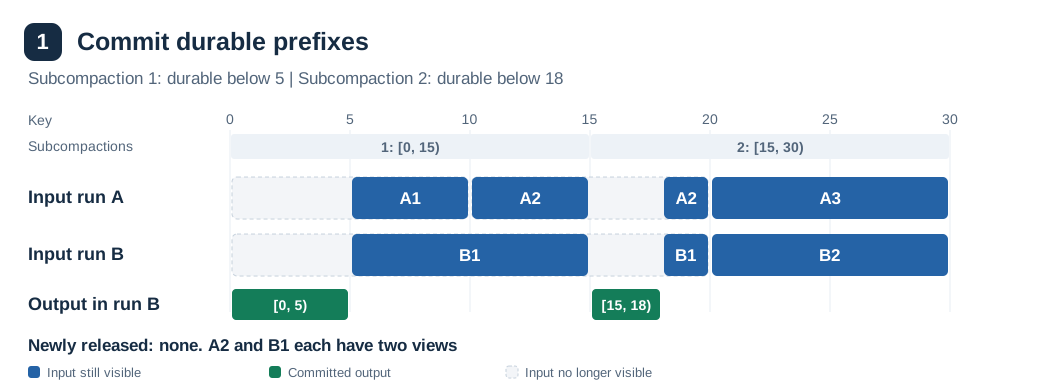
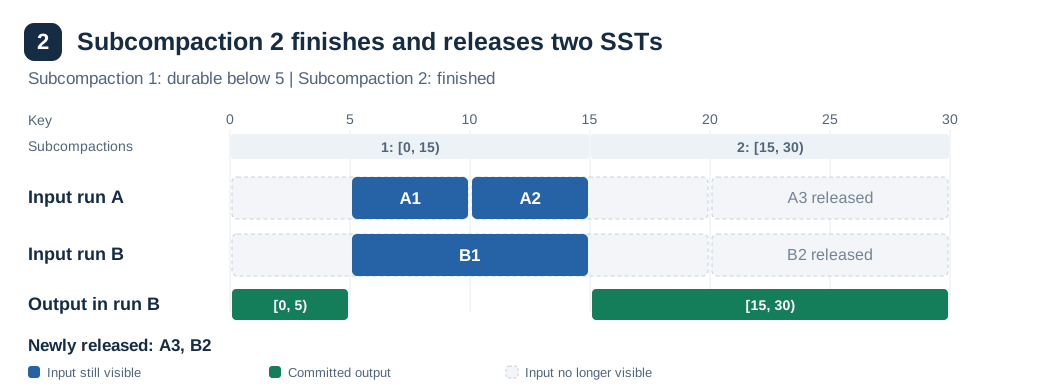
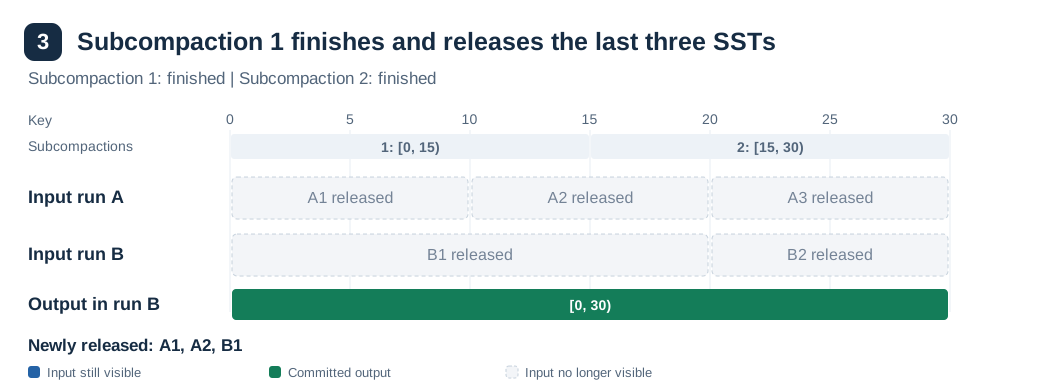
Each step shows the manifest after a commit. Output bars represent key intervals of output in run B, not individual output SST boundaries. The diagrams show the retained inputs of run B and the output in run B on separate rows, but both are views in the same run.
Step 1: Commit durable prefixes
Section titled “Step 1: Commit durable prefixes”Subcompaction 1 has a durable interval of [0, 5), and subcompaction 2 has one
of [15, 18). The coordinator commits both intervals. A1 keeps a narrower view.
A2 and B1 each split into two views because [15, 18) falls inside them.
Every input SST keeps at least one view, so the commit releases no SSTs.
Step 2: Commit subcompaction 2’s range independently
Section titled “Step 2: Commit subcompaction 2’s range independently”Subcompaction 2 finishes. The coordinator commits both [0, 5) and [15, 30).
This releases A3 and B2. The views of A2 and B1 that cover [18, 20) are
removed, so A2 and B1 each keep one view while subcompaction 1 continues.
Step 3: Commit the remaining gap
Section titled “Step 3: Commit the remaining gap”Subcompaction 1 finishes. The final commit covers [0, 30), including the
remaining gap [5, 15). It releases A1, A2, and B1, and removes run A. Run B
now holds only output.
Durable progress
Section titled “Durable progress”The worker records each subcompaction’s planned range and full output list in
.compactions, as it does today. A new status for each subcompaction
records whether the worker finished the range and stored all its output. See
Schema changes. The Completed status also covers ranges
that produce no output.
For an unfinished range, the coordinator takes the boundary key B from the
last recorded output SST’s CompactedSsTable.info.last_entry metadata. This
avoids reading the SST’s index and final block.
The durable prefix is [range.start, B). It excludes B because more versions
of that key can follow in later output SSTs. A commit must exclude every
version of B, including versions in earlier output SSTs.
As the worker records later SSTs, B can advance without waiting for the
subcompaction to finish. When the status of the range is Completed, the
durable interval covers the whole planned range.
The coordinator must use progress at least as recent as its previous commit.
Output lists only grow, and a subcompaction status never changes from
Completed back to InProgress.
Output in the destination run
Section titled “Output in the destination run”After an incremental commit, the destination run holds two kinds of views: committed output views and retained input views of the destination run. The coordinator tells them apart by SST ID. An SST in the recorded output lists of the job is output. Every other SST in the destination run is input.
Output views cover the durable intervals. Retained input views cover the rest of the key space. The two sets do not overlap, so the destination run stays a valid sorted run with views in key order.
The destination run keeps its ID and its position in the manifest. Incremental compaction does not change how the scheduler assigns run IDs or orders runs.
Updating the manifest
Section titled “Updating the manifest”The manifest stores the current input views and output views. The coordinator
uses the recorded plan and output lists in .compactions to rebuild these views.
The scheduler reserves all input runs, including the destination run, until
the job reaches a terminal state in .compactions. Other compactions cannot
use these runs during incremental commits.
The coordinator prepares the next manifest for a batch as follows. Steps 1 through 4 apply to each job.
- Subtract all durable intervals from each input view, preserving any preexisting gaps or projections. Make one view for each interval that remains, and remove the view if no keys remain.
- Keep every input run, including empty runs, until the final commit.
- Rebuild the output views from the full recorded output list, clipped to the durable intervals. The rebuild is safe to repeat.
- Set the views of the destination run to its retained input views and the output views, ordered by key.
- Add a checkpoint that references the manifest version being replaced.
- Write the checkpoint and run changes in one manifest CAS.
When an input view narrows or splits, each retained piece receives a fresh view ID. A clipped output view also receives a fresh view ID each time the coordinator rebuilds it. Unchanged views keep their IDs. Step 1 of the example shows A1 narrow and A2 and B1 split.
On a CAS conflict, the coordinator refreshes metadata objects and rebuilds from the current manifest and durable job state.
Stored progress and recovery
Section titled “Stored progress and recovery”Workers resume execution from .compactions. The coordinator uses the same
state to prepare manifest updates.
Workers claim Scheduled jobs as Running and mark them Compacted after
execution. If a heartbeat expires, the coordinator reassigns the job.
An unfinished subcompaction resumes after the last entry in its last recorded
output SST. Completed subcompactions, including empty ones, do not run again.
Each job in .compactions stores a TieredCompactionContext, which holds the
subcompactions and the retention sequence of the job. Today, only workers read
it. With incremental compaction, the coordinator also reads the range plan,
the output lists, and the subcompaction status in it. After a job is scheduled,
workers cannot re-plan it:
- A worker must not change the planned range of a subcompaction.
- A worker must not remove or reorder recorded output SSTs. It can only append output SSTs to a range.
- A worker can change the status of a range only from
InProgresstoCompleted. - A worker must not clear the
TieredCompactionContext.
On restart, the coordinator still sends Scheduled jobs through Submitted
for revalidation. Revalidation keeps the TieredCompactionContext and requires
every input run ID to remain present. It accepts output views that an earlier
incremental commit added to the destination run.
Recovery rebuilds views from all durable intervals. If the coordinator crashed before an incremental commit, the next commit applies the same views.
The coordinator writes the final manifest after .compactions records
Compacted, and then records Completed. If it crashes before the manifest
write, recovery retries the final commit. If it crashes after the manifest
write but before recording Completed, the input runs other than the
destination are absent, and the destination run holds only recorded output SSTs.
Recovery then records Completed without changing the manifest.
Deleting released inputs
Section titled “Deleting released inputs”A commit releases an SST when the new manifest no longer references any view of that physical file. The coordinator compares physical SST IDs across all trees in the current manifest and the new manifest for the complete batch. Splitting or narrowing views does not release an SST while any view still references it.
Each commit adds a checkpoint of the preceding manifest to protect existing readers. This is the same short-lived checkpoint that the compactor writes today when it updates the manifest. In the example, each of the three steps adds a checkpoint.
GC can delete a released SST only when no current or checkpointed manifest references any view of it. Its ID timestamp must also fall below the GC cutoff. RFC-0029 describes the age and watermark limits that set this cutoff.
Commit timing and configuration
Section titled “Commit timing and configuration”The coordinator already polls .compactions every compactions_poll_interval
to find finished jobs, as RFC-0025 describes.
The incremental commit interval is one minimum interval between incremental
commits across all jobs handled by the coordinator. Once
that interval has elapsed since the last incremental commit, the coordinator
uses its next poll to derive durable intervals from the output and status
records already stored in .compactions and commits them. Final commits happen
on any poll that finds a Compacted job and do not wait for this interval.
Incremental commits apply only to sorted-run compactions. Compactions with L0 inputs commit only at completion, so L0 watermark management does not change.
The incremental commit interval starts as an internal constant. Will be set
based on testimg. If users need to tune it, a later change can expose it in
CompactorOptions.
CompactorOptions gets a new field to turn the feature on:
pub struct CompactorOptions {    // ... existing fields ...
    /// Commits the durable progress of running compactions to the manifest    /// before they finish.    pub enable_incremental_compaction: bool,}
The default is false, which disables incremental compaction. We can remove
that field later once we confirm incremental compaction is stable.
Schema changes
Section titled “Schema changes”Incremental compaction adds one field in .compactions. The manifest schema
does not change, because SortedRunV2 and CompactedSsTableView already
store views with a visible_range.
Subcompaction in schemas/compactor.fbs gets a status enum:
enum SubcompactionStatus : byte {    /// The worker has not finished this range. This includes ranges that    /// did not start. More output SSTs can follow.    InProgress = 0,    /// The worker processed all input in this range and recorded all its    /// output SSTs, including ranges that produce no output.    Completed,}
table Subcompaction {    range: BytesRange (required);    output_ssts: [CompactedSsTable];
    // Appended after existing fields so vtable offsets for earlier fields    // remain stable. Records written before this field existed read as    // `InProgress`.    status: SubcompactionStatus;}
The Rust Subcompaction struct gets a matching status field. An enum
instead of a boolean flag leaves room for more states later.
Impact analysis
Section titled “Impact analysis”Marked items identify implementation areas that change or need correctness testing. The public KV API and query semantics remain unchanged.
Core API & query semantics
Section titled “Core API & query semantics”- Basic KV API (
get/put/delete) - Range queries, iterators, seek semantics
- Range deletions
- Error model, API errors
Consistency, isolation, and multi-versioning
Section titled “Consistency, isolation, and multi-versioning”- Transactions
- Snapshots
- Sequence numbers
Time, retention, and derived state
Section titled “Time, retention, and derived state”- Time to live (TTL)
- Compaction filters
- Merge operator
- Change Data Capture (CDC)
Metadata, coordination, and lifecycles
Section titled “Metadata, coordination, and lifecycles”- Manifest format
- Checkpoints
- Clones
- Garbage collection
- Database splitting and merging
- Multi-writer
Compaction
Section titled “Compaction”- Compaction state persistence
- Compaction strategies
- Distributed compaction
-
.compactionsformat
Storage engine internals
Section titled “Storage engine internals”- Write-ahead log (WAL)
- Block cache
- Object store cache
- Indexing (bloom filters, metadata)
- SST format or block format
Ecosystem & operations
Section titled “Ecosystem & operations”- CLI tools
- Language bindings (Go/Python/etc)
- Observability (metrics/logging/tracing)
Operations
Section titled “Operations”Performance & cost
Section titled “Performance & cost”Each committed batch adds one manifest version and one checkpoint. With an incremental commit interval of 1 minute, incremental commits add at most one manifest version per minute. Shorter commit intervals increase coordinator work and metadata writes. Conflicts require additional write attempts.
Checkpoint retention and GC delays determine when released SSTs free disk space.
Observability
Section titled “Observability”CompactionStats gets one new counter, incremental_released_bytes, next to
jobs_claimed and jobs_reclaimed. It counts the bytes of input SSTs that
incremental commits release before the final commit. This shows how much
space becomes free before compactions finish.
Compatibility
Section titled “Compatibility”Incremental compaction is disabled by default.
The new status field in Subcompaction is additive. Older records read as
InProgress, as Schema changes describes.
Testing
Section titled “Testing”- Regular unit test coverage.
- Fault injection and recovery tests.
- Testing on a large dataset (e.g. 1TB) and confirm that released bytes and GC makes incremental compaction can do what it’s intended for.
Rollout
Section titled “Rollout”- Feature will start as false until we confirm it’s stable then we can make it always enabled and remove the knob to enable it.
Alternatives
Section titled “Alternatives”Status quo
Section titled “Status quo”Keep the current behavior, where the manifest references all input SSTs until the compaction finishes. A deployment that mirrors data on local disk, as described in RFC-0034, then keeps both the inputs and the output of a compaction on disk until the final commit. This transient space amplification can need up to twice the size of the compacted data, so the mirror wastes a large amount of disk space.
Leveled compaction
Section titled “Leveled compaction”Leveled compaction rewrites small key ranges in each compaction, so it needs less temporary space. But it is a different compaction strategy, not a change to the current one. It loses the benefits of size-tiered compaction, such as lower write amplification.
Open questions
Section titled “Open questions”Output in the destination run or in a new sorted run
Section titled “Output in the destination run or in a new sorted run”Question: Keep the destination run as the oldest input run, as it is today, or write the output to a new sorted run?
Answer: Keep the destination run as it is today. A new sorted run removes the need to keep input views and output views together in the destination run, but this benefit is small. A new sorted run for the output can be follow-up work. #2115 tracks the first step, which makes sorted run IDs ULIDs that do not define run order.
References
Section titled “References”- RFC-0002: Compaction, in particular the position on transient space amplification.
- RFC-0024: Segment Oriented Compaction, the origin of projected SST views in the manifest.
- RFC-0025: Distributed Compaction, the coordinator and worker split and the manifest commit protocol.
- RFC-0028: Subcompactions, per range output SSTs and the resume cursor.
- RFC-0029: GC Safe SST ULID Timestamps, the compaction low watermark that protects output awaiting a commit.
- Maximizing Disk Utilization with Incremental Compaction, ScyllaDB, the origin of this approach.

Copyright © SlateDB. All rights reserved. For details on our trademarks, please visit our Trademark Policy and Trademark List.
Trademarks of third parties are owned by their respective holders and their mention here does not suggest any endorsement or association.